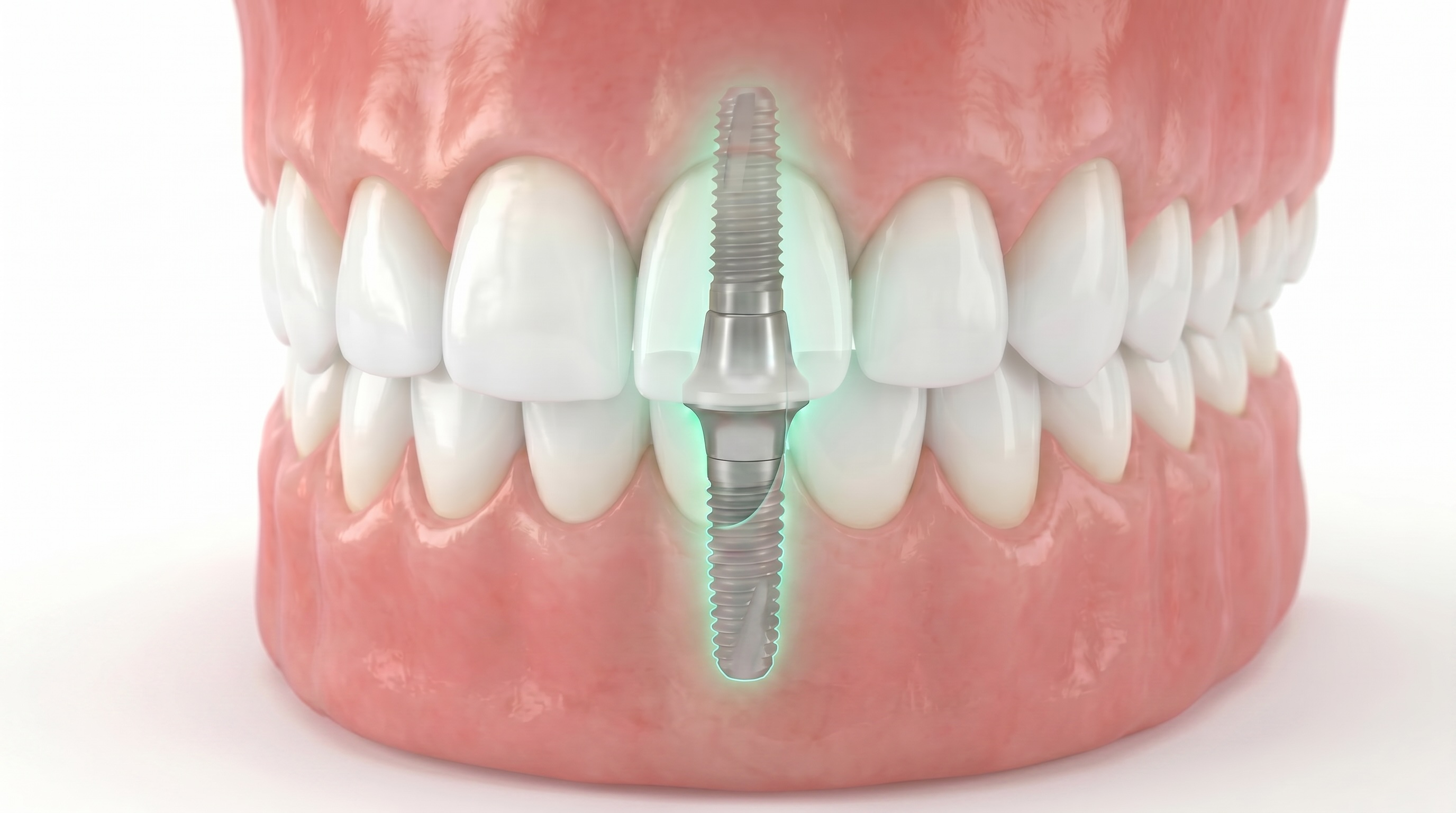
The gold standard for replacing missing teeth — a titanium implant integrates with your jaw to support a crown, bridge or denture that feels and works like your own tooth.
How implants work
A replacement built from the root up
A dental implant is a small, biocompatible titanium post placed into the jawbone, where it fuses with the bone in a process called osseointegration. This creates a stable foundation for a custom crown that matches your surrounding teeth.
Unlike a bridge, an implant doesn't rely on grinding down neighbouring teeth — and by stimulating the bone, it helps prevent the bone loss that follows tooth loss.
Looks, feels and functions like a natural tooth
Protects neighbouring teeth from being altered
Helps maintain jawbone and facial structure
Built to last with good care and maintenance
Tailored to you
From one tooth to several
Implants are versatile — the right approach depends on how many teeth are missing and the health of your gums and bone.
Single tooth
One implant and crown to fill a gap without affecting the teeth on either side.
Multiple teeth
Several implants supporting an implant bridge to replace a run of missing teeth.
Implant-secured dentures
Implants that anchor a denture so it stays firmly in place and feels secure.
Your treatment journey
The implant process
Consult & scan
An exam and 3D CBCT scan assess your bone and plan the ideal implant position.
Placement
The implant is precisely placed, often with computer-guided surgery for accuracy.
Healing
The implant integrates with bone over a few months while you wear a temporary if needed.
Crown fitted
A custom crown is attached, completing your natural-looking, fully functional tooth.
Common questions
Dental implants, answered
Is implant surgery painful?
Implant placement is performed with local anaesthetic and most patients are comfortable throughout. Any post-operative tenderness is usually mild and managed with simple pain relief. We'll give you clear aftercare guidance.
How long do dental implants last?
With good oral hygiene and regular check-ups, implants can last many years — often decades. The crown on top may need replacing over time, much like any restoration with normal wear.
What if I don't have enough bone?
If bone volume is reduced, bone grafting or a sinus lift may be recommended to build a solid foundation first. This is assessed from your 3D scan and discussed as part of your plan.
Am I too old for implants?
There's no upper age limit — suitability is based on your general health and the condition of your gums and bone, not your age. Many older adults are excellent implant candidates.
The first step
Replace what's missing — comfortably
Book a consultation to find out whether dental implants are right for you and receive a clear, personalised plan.
This website uses cookies to understand how visitors use the site (via Google Analytics). By continuing to browse, you consent to this.
Privacy & Cookies Policy
Privacy & Cookies Policy
Dr Diana Arcila — Implant & Oral Surgery, Sydney. Last updated: July 2026.
This policy explains how this website and practice collect, use and protect your personal information. As a health service provider, the practice is bound by the Privacy Act 1988 (Cth) and the Australian Privacy Principles (APPs), regardless of its size.
Information we collect
When you use the enquiry form we collect the details you provide — such as your name, email, phone number and message. When you browse the site, we collect anonymous usage data through Google Analytics, including pages viewed, approximate location, and device and browser type. We only collect what we reasonably need.
Cookies & analytics
This site uses Google Analytics, which sets cookies to measure how the site is used so we can improve it. This data is aggregated and does not identify you personally. You can block or delete cookies in your browser settings, or opt out using Google’s opt-out add-on.
How we use your information
We use your information to respond to your enquiry, to provide and manage dental care, and to understand and improve the website. We do not sell your information or use it for unrelated marketing.
Health & sensitive information
Any health information is treated as sensitive and handled with strict confidentiality in line with the APPs. Photographs or images are only ever used in advertising with your separate, specific written consent.
Sharing & storage
Your information is stored securely. It may be handled by trusted service providers who help run the website (for example, our host Netlify and Google Analytics), and may be disclosed where required or authorised by law. We take reasonable steps to protect it from misuse, loss and unauthorised access.
Your rights
You may ask to access or correct the information we hold about you, and you may make a privacy complaint at any time by contacting us. If you are not satisfied with our response, you can contact the Office of the Australian Information Commissioner (OAIC) at oaic.gov.au.